Five years ago, if you didn’t understand something you would look it up on Google. Google was known as a student’s saving grace; whether it was used properly for research or looking up the answers to a homework assignment, Google was one of the most impactful search engines out there. However, it was commonly known as severely damaging to a student’s education, and one of a teacher’s worst enemies. Over the past few years, the search engine itself has slowly faded into the background to make way for their new “AI Overview” courtesy of Google Gemini. AI in general, especially ChatGPT, has recently become some students’ default way of learning. Although, calling it learning is giving students too much credit. By replacing actual learning with mindlessly asking AI to complete assignments, students ruin their own educational prospects. Schoolwork, rather than an enriching exercise, becomes busy work.
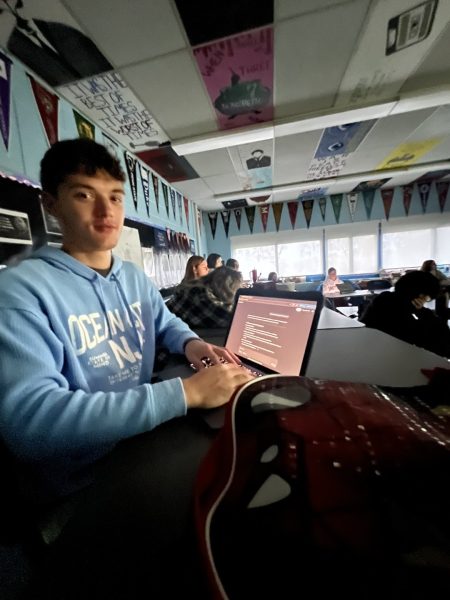
During an English class discussion the other day, I found it fascinating to learn about the various ways students use ChatGPT. Some students use it for almost all of their assignments, while others use it to knock out pointless assignments they believe they won’t need for the rest of their life. ChatGPT is supposed to be a “tool for learning, not a replacement,” as Mrs. Myones recalls. The whole “having AI do your essay” isn’t an idea students should follow throughout their education. Learning how to write an essay is a key skill to learn, but students are instead feeding the prompt into an AI engine to do it for them. There have been multiple articles with recent research supporting my claim that AI is negatively impacting students. According to a research experiment at MIT, where ChatGPT-using students wrote SAT level essays multiple times, their lacking effort resulted in underperformance and uncreative essays.
During my class discussion, senior Michael Tompkins commented, “AI affects the learning process around us by almost taking away the reason for the teacher to be there. People are more inclined to ask AI for answers instead of going to a teacher for help.” AI is truly harming students’ capabilities to communicate with their teachers. When students are too afraid to talk to their educators, they turn to AI, as if it was their best friend. In some instances, a teacher may be more difficult to approach than others; but without AI, you would be forced to ask questions that are on your mind instead of defaulting to ChatGPT. Asking the questions that you are afraid to ask is an important way for students to grow. When that opportunity is taken away, a life skill suddenly becomes nonexistent.
The world is changing with the addition of AI advancement – but should it really have a place in our school systems?
In my opinion: yes. AI has the ability to help students learn, but can only do so by giving directions to develop the question or problem further – instead of giving them the answer straight Agreeingly, Tompkins continues, “I think it should have a place, however it should have some restrictions.” The biggest restriction with AI in school systems is banning the act of plagiarism, (which can be pretty easy to detect in this day and age), but that doesn’t mean it’s going away anytime soon. I believe the solution to this problem lies within teachers’ abilities to embrace advancing AI, encouraging students to use it the right way, and utilizing it as a springboard for further independent learning.