

The transfer portal is now the college equivalent of free agency in the NFL, NBA, and other American professional sports. For most of college sports history, players were unpaid aside from simply being on scholarships. In 2021, NIL rules were introduced, so players could earn money from things like advertisements, social media, and by making public appearances. Now, though, in the first offseason of College Football since the House v. NCAA ruling over the summer 2025, which allowed players to be directly signed and paid by schools, the numbers are proving that the transfer portal is out of control.
In the years before 2018, transferring schools was a much longer and complicated process than it is now. Non-graduating students had to sit out a year, and needed permission from their coach. So, players like Baker Mayfield and Kyler Murray were able to transfer because they didn’t see eye to eye with their coach. Both players sat out a year at Oklahoma, as they both transferred there, and would end up winning the Heisman Trophy in their time at the school. Both players were also first overall picks in 2018 and 2019.
So, the transfer portal used to be used for players who needed a chance to start in order to better their chances at making the NFL. Now, though, it seems to be a way for players to maximize the amount of money they can make at college. Just a couple of weeks into the portal, 2,900 players have entered, and the number is still going up. Players are trying to get as much money as possible while in college, rather than using college football as a step to the NFL.
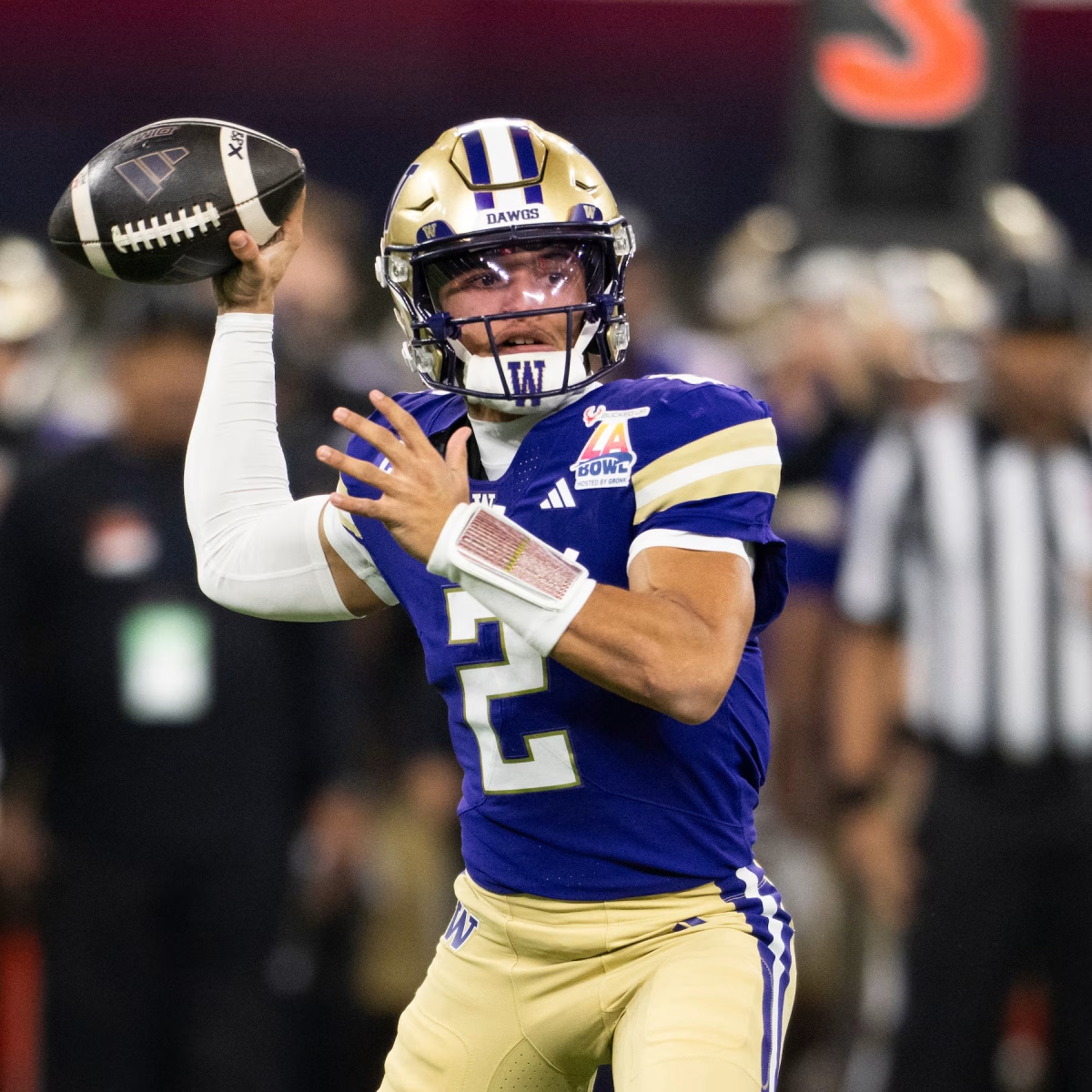
In all fairness, you cannot really fault the players for wanting this. No money is guaranteed in the NFL, especially for players who may not be skilled enough to play professionally. However, in some cases, transferring doesn’t make a lot of sense. Washington sophomore QB and projected future top pick Demond Williams Jr. signed a contract with Washington worth around 4 million before entering the transfer portal in the same week. After the school took legal action and Williams was dropped by his agents, Williams withdrew from the portal and chose to stay at Washington.
Another reason as to why so many players transfer now is because of how often coaches get fired and hired. Wanting the chance to play under a coach you choose makes sense, and this is a reason so many former starters transferred this year. This year during the season, head coaches at Penn St., LSU, Florida, Auburn, Virginia Tech, UCLA, Michigan, Florida, and several other power 4 schools were all fired. Cam Coleman, former Auburn WR, transferred after Hugh Freeze, the head coach, was fired. The same is with Justice Haynes, his coach was fired, and he is estimated to make around $750,000 to wherever he transfers too. He is estimated to make ~$2.5 million in Texas.
The big issue when it comes to the transfer portal now is that a large number of schools are now viewed as stepping stones to bigger schools and bigger contracts. Eric Singleton, former Georgia Tech WR, started for two years with the team before leaving for Auburn. Dylan Raiola also started for Nebraska at the QB position for two years, before transferring to Oregon a couple weeks later. Another more extreme example is QB TJ Finley, who has spent time with LSU, Auburn, Texas St., Tulane, Western Kentucky, Georgia St., and will now spend a year at Incarante Wood.
As for what can be done to “fix” the transfer portal issue so that less players enter every year, some rule changes could be made that are very simple. A solution that many fans propose to lower the amount of transfers is to allow one free transfer per player, and then another free one only if a major coaching change takes place at your school. This would reward lower end power 4 teams the most, as former backups from big schools like Oregon or Ohio St. could immediately make an impact at these schools. Also, transfers from mid-major schools like Marshall, JMU, and Tulane, for example, could perform well with lower competition and try to take a shot at transferring to a power 4 team, even if it’s lower on the spectrum. Seniors Nick Carreira and Joe Marrara both agree, stating that “players shouldn’t be allowed to leave for no reason,” and that “the NFL is where players should prioritize money. College football is meant to prepare them for that.” A salary cap could also prevent schools from outfunding each other and keep competition more stable.
Many fans online and at Hills agree that some restrictions should be placed on the transfer portal in order to keep the sport different from the NFL. Despite that, college sports are changing. Athletes are being paid now, and that is not a decision that will just be overrode at some point. As the number of players entering the transfer portal continues to increase, fans of college football remain on the lookout for player and team updates.