

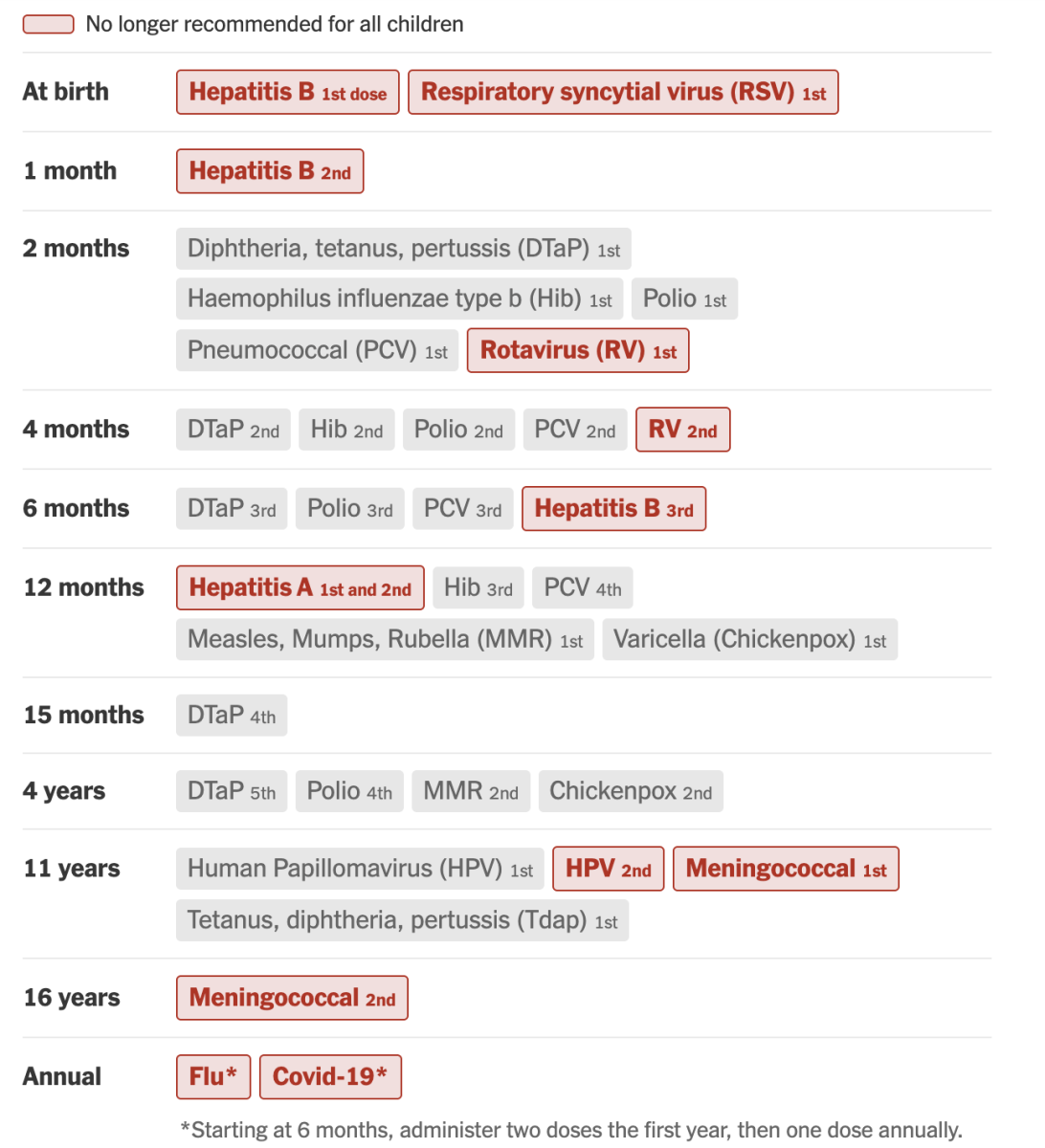
Since birth, immunizations have been given to infants to protect them against diseases from around the world. Children throughout passing generations have been administered influenza (flu), MMR/MMRV (measles), RSV (respiratory syncytial virus), IPV (polio), and hepatitis B vaccinations. In late 2025, a federal vaccine committee took steps toward Department of Health Secretary Robert F. Kennedy’s overall goal of rebranding the childhood vaccine schedule. This first step consisted of a panel voting to no longer recommend the hepatitis B vaccination for infants, putting them at high risk for contracting the infection.
According to the CDC, hepatitis B is a vaccine-preventable viral infection of the liver that is caused by HBV. HBV is transmitted when blood, semen, or other bodily fluids from an infected person enters the body of an uninfected individual (CDC). Hepatitis B (hep. B) can come in two forms, acute and chronic, which vary in severity. Acute hep. B is a short term illness that commonly occurs within the first six months after exposure to HBV. On the other hand, chronic hep. B is a lifelong illness that can cause liver damage, cancer, or even death. There is a large spectrum of symptoms that result from this infection, ranging from fever to jaundice.
This infection has been relevant for decades with its first cases recorded in 1883 and blood transmission further examined in 1943 (CDC). With years of knowledge to back the dangers of this infection, why stop recommending infant vaccinations now? The answer to this can be discovered in a New York Times article, authored by Apoorva Mandavilli, a global health reporter, that asserts, “Mr. Kennedy and his associates have argued that Hepatitis B is primarily a sexually transmitted disease and that babies do not need the protection unless their mothers are infected.” Although HBV can be spread in this way, the virus can also be transmitted from everyday objects like toothbrushes or combs. Additionally, not all individuals at the point of transmission present with symptoms even though they have hepatitis B. It can take weeks or even months to get symptoms or become aware that one is infected.
Physicians, especially pediatricians and nurses, learn all there is about pharmaceuticals during school, residencies, clinicals, and more. Dr. Cody Meissner, a professor of pediatrics at the Dartmouth Geisel School of Medicine affirms that the hepatitis B vaccine is “safe, and we know it’s very effective.” Additionally, Dr. Meissner warned that if this proposal passed, which it inevitably did, “we will see more children, adolescents, and adults infected with hepatitis B.”
While the federal government is making these recommendations, that doesn’t necessarily mean the states have to abide by them. The New Jersey Department of Health has taken a clear stance on the issue. They’ve stated in a recent report, “Federal efforts to reduce the number of vaccines recommended for all children in the United States are not supported by the available data nor the consensus of public health and medical experts. Instead, deterring participation in vaccination risks leaving children vulnerable to serious and preventable infections.” In the same report, they stated that all school mandatory vaccinations will remain the same regardless of recently stated recommendations. Senior Nehali Reddy, a student in the UPSMR program, explains, “I don’t think it’s right to not immediately vaccinate infants for Hepatitis B. Infants are the most vulnerable and their immune systems need to be protected against infections. Most pediatricians recommend early vaccination, so I’m glad New Jersey supports continuing infant vaccinations.”
As the government moves to adjust the official nationally recommended vaccination schedule, one could predict a shift of civilian opinions with regards to the topic of vaccination and Hepatitis B. As time progresses, some states might shift their views to align with the new federal hope of making the United States similar to other foreign nations’ medical standards.