

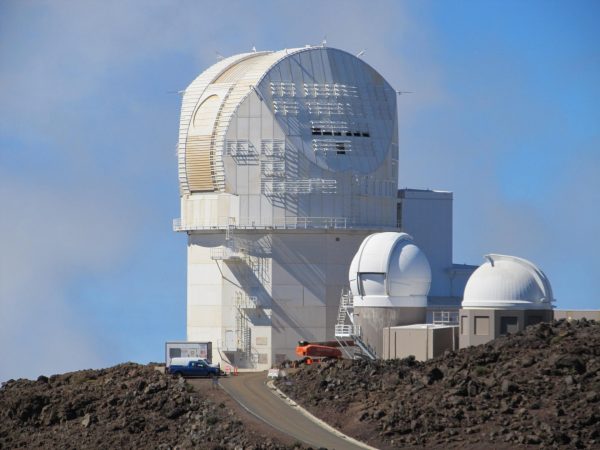
The resurgence of an exciting discovery made in August of 2025 has taken astronomers, and the world, by surprise: a small asteroid, or quasi-moon, has been spotted from the Pan-STARRS observatory on Haleakala in Hawaii. The asteroid was named Arjuna 2025 PN7, and it was declared a quasi moon: an object in space that appears to be orbiting a planet from their point of view, but is not actually in the planet’s orbit. The way the little asteroid orbits the sun mirrors the path of an object that is orbiting the Earth like the moon orbits our planet, creating the illusion that it is in Earth’s orbit.
The 2025 PN7 is only about 19 meters, or 62 feet in diameter, and is expected to remain a quasi-moon until approximately 2083, according to NASA. The asteroid has been in close proximity to Earth for many years, however, it drifted a little closer to Earth over the past few months, allowing NASA technology to pick up on the object and collect data about it. Due to its size, it won’t be visible by the human eye, or even a standard telescope–advanced telescopes that use technology not available to the public are required to view the quasi-moon.
Our temporary quasi-moon is part of the Arjuna class of asteroids: a group of Earth-like objects that orbit the sun similarly to Earth, but not in Earth’s gravitational field. With more than 100 NEO (Near Earth Objects), the Arjuna asteroids make up the Arjuna Secondary Asteroid belt, located between the orbits of Mars and Jupiter.
The 2025 PN7 has led many, including junior Alexander Noerr to wonder about other quasi-moons near Earth, “Wow! Freaky! Are there any more quasi-moons, or does our planet only have two friends?” While we likely do have other quasi-moons in relatively close proximity, NASA has not declared that any of these other moons are close enough to be considered a quasi-moon of Earth.
Junior Jordan Stashi comments, “It’s so cool that scientists think this has been around us for years, but are only now discovering it. I wonder what else is out there that we don’t know about.” Stashi poses a fair question: if space stations observe new activity in space only when it comes close enough to be in our satellites’ range, determining what does and doesn’t exist in space is even more difficult. This shocking discovery has inspired curiosity in many about space exploration and research.
Freshman Alexa Portsmore wonders, “If we only just discovered this new quasi moon, is it possible that this asteroid is headed towards Earth?” It’s not. The closest the 2025 PN7 will ever come to Earth is about 4 billion light years. When the asteroid eventually drifts out of our satellite range in about 60 years, it will move on with the rest of the Arjuna class, away from Earth.
So, the 2025 PN7 isn’t a Star Wars adjacent second moon to Earth, unfortunately, but it is a significant, yet temporary, member of our solar system.