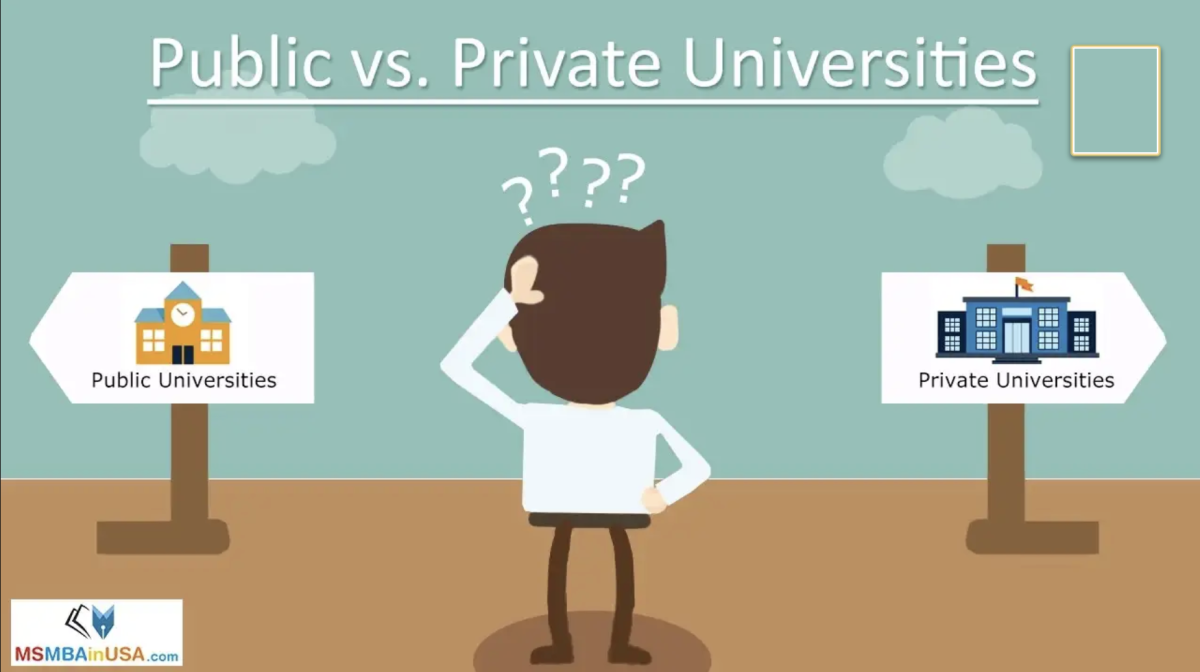
 With the Class of 2026 deciding on what colleges they wish to get into nationwide, many of them are skeptical whether they want to attend a public or private university. Public universities/colleges are higher education institutions that are mainly funded by the state governments, according to BestColleges. As for private/public institutions, they rely heavily on student tuition fees, alumni donations, and endowments to fund their programs. There is also a difference between non-profit and for-profit private colleges/universities. For-profit colleges are run as businesses so they must be concerned about generating profits while non-profits focus on providing students with a quality education. Therefore, non-profit private colleges usually have a better reputation compared to for-profit private colleges.
Another difference between private and public colleges/universities is the cost of attendance, program offerings, research opportunities, and of course, financial aid. Public universities/colleges are able to have lower tuition rates due to their funding by state and federal governments. This is essential for students who live in-state as they can be charged less compared to someone who doesn’t live in-state. From the school year 2020-2021, the average tuition for a four-year public college was $18,809 for out-of -state students and only $8,487 for in-state students according to the National Center for Education Statistics. As for the tuition cost for private universities/colleges, it would typically start at $30,065 for out-of-state and in-state. There is also a difference between class sizes. For example, depending on the place, public universities/colleges will have a class size of minimum 100 students. As for some private universities/colleges, they could have a 35-60 student capacity in their classes.
Furthermore, program offerings and research opportunities are just as important to the student. For a public university/college, the government funding is able to provide a large array of research facilities and labs while private colleges and universities have fewer student resources and research facilities.
The last thing that students are worried about is financial aid. If they are from an upper-class family and their guardian is willing to pay tuition, then they will not have to worry about paying for college/university. But what if they did not have the money? Both private and public universities/colleges offer financial aid to every student, but it varies depending on their parents income. This is why we have the FAFSA, CSS Profile, and plenty of other options to pay for college through scholarships that are given out every year to rising seniors or current high school seniors. Oftentimes, whatever college offers the highest amount of aid, is the college the student will choose to attend. An example is if a student who comes from a middle-class family (making under $75,000 per year), and they get offered $9,500 a year to attend a public university/college, but their other college offers them $50,000 a year, they would most likely take that option over the $9,500.
Indian Hills Guidance Counselor, Andrew Imperatore weighed in with his opinion on the matter of private or public institutions. He stated, “I emphasize that public universities offer the benefit of lower tuition for in-state residents due to state funding. Conversely, private colleges provide the benefit of smaller class sizes and lower student-to-faculty ratios, fostering a more intimate learning environment. The negative, however, is almost universally the higher ‘sticker price’ tuition, though substantial financial aid can often reduce the true final cost.”
Overall, there are many preferences, pros and cons, and ideal way of living for students who wish to attend college/university. Between private and public, non-profit or for-profit, aid, programs, sports, etc, in the end, it is what the student prefers.