As many students start to wrap up the second half of high school, they begin to focus on the age-old question, “what do I want to be?” While many may have a plan on what they want to pursue, they might change their mind once they hear that the profession they’ve been dreaming of is now “unprofessional”.
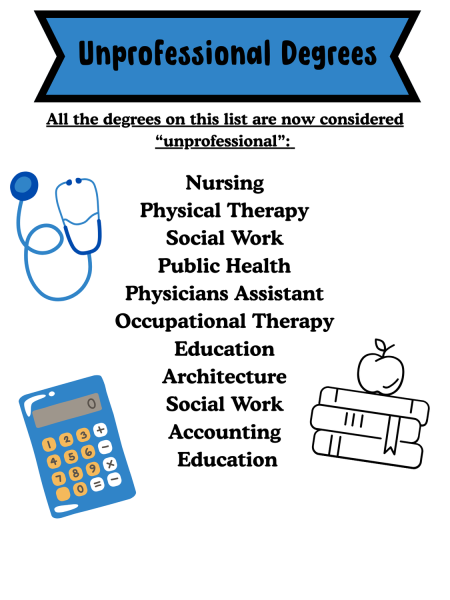
A professional degree was described in a 1965 law as “both completion of the academic requirements for beginning practice in a given profession and a level of professional skill beyond that normally required for a bachelor’s degree” (USA Today). Some of the professional majors over the years have included law, medicine, and dentistry to name a few. However, in July of 2025, President Donald Trump introduced the “unprofessional vs professional” degree debate. In August, a decision was reached by Trump and the American Council On Education to classify majors such as nursing, physical therapy, occupational therapy, speech therapy, social work, public health, architecture, accounting, and educators as unprofessional degrees. The American Nurses Association has expressed clear concern and discontent through the association’s president Jennifer Mensik Kennedy. In a letter Kennedy said that excluding nursing from the “professional degree” list will “severely restrict access to critical funding for graduate nursing education, undermining efforts to grow and sustain the nursing workforce.”
The biggest issue with these new “unprofessional degrees” is what it does to student loans for students pursuing these degrees. President Donald Trump’s “Big Beautiful Bill” could drastically affect how much money students are allowed to borrow. This bill eliminated the Grad PLUS loan program which has helped students pursue the careers of their choice. According to Greg Garrison, a consumer banking analyst for US News And World Report, clarifies that graduate students looking to pursue a professional degree will be allowed to borrow up to $50,000 in federal loans for an academic year and $200,000 in a lifetime. While students looking to pursue an unprofessional graduate degree can only borrow $20,500 in an academic year and $100,000 in total, a significant difference from degrees considered to be professional.
These changes to degrees and loan caps will officially go into effect on July 1st, 2026. So, even though they won’t affect the current senior class of Indian Hills, it will greatly affect the Class of 2027, 2028, and 2029. Students considering majors in nursing, accounting, education, etc. might have to reconsider their choices. Junior Mark Havel, a student interested in a professional degree, comments, “I feel extremely sorry for people interested in an unprofessional degree where loans are being cut. It’s unfortunate that vital loans are being taken away from the backbone of our society, like nursing.”
In the following academic year, students may have to pay closer attention to how student loans will affect their academic, and post academic lives. Unfortunately, some may be faced with the challenge of shifting their desired careers.