

On February 2, Punxsutawney Phil made his prediction for the winter, claiming that it would last for another six weeks. Every year on Groundhog Day, Phil makes his weather forecast for the winter, depending on whether he sees his shadow or not. If he sees his shadow, like this year, he foretells a longer winter, but if he does not, he predicts an early spring. Although he has been forecasting the weather since the late 1800s, he has only been right about 35% of the time in the last 20 years. So, what have weather experts been saying about the rest of the winter?
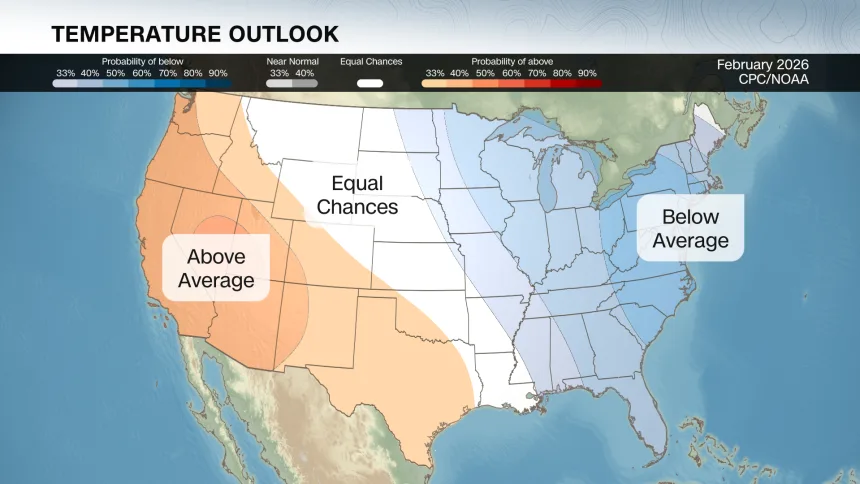
At the National Weather Service’s Climate Prediction Center (CPC), meteorologists make predictions for temperature and precipitation across the US, ranging from a week to more than a year in advance. For February, they predicted colder-than-normal temperatures in the East, yet warmer-than-normal temperatures in the West and Southern Plains. However, according to The Old Farmer’s Almanac, the region containing New Jersey, the Atlantic Corridor, is predicted to have a milder and drier winter with above-normal temperatures. Luckily for us, it is predicted that the coldest periods have already passed. The snowfall for this year is also below normal, with the snowiest periods predicted in late December, early January, and late February.
Even with prediction tools, it is hard to make completely accurate long-range forecasts. There have been brutally cold temperatures throughout the East, with multiple places in the Great Lakes, Northeast, and mid-Atlantic experiencing one of their 10 coldest winters in history. The cold has even been fatal for numerous Americans, as seen in the historic winter storm that occurred at the end of January. However, in the West, at almost 150 locations including Phoenix and Las Vegas, residents are experiencing their warmest winter to date. According to Climate Central, winter is now the fastest-warming season for almost 75% of the US due to climate change. Since 1970, winter temperatures have increased by 3.8 degrees Fahrenheit on average. While brutal cold and winter storms can still occur in a warmer climate, they will become less frequent and less extreme.
https://www.cnn.com/2026/02/02/weather/groundhog-day-shadow-winter-spring-climate
https://www.cnn.com/2023/12/21/weather/us-winter-temperatures-climate-change/index.html
https://www.almanac.com/winter-extended-forecast-farmers-almanac