

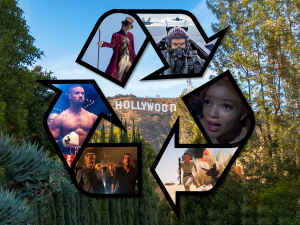
When was the last time you went to the theater to see a movie you knew nothing about? How about the last time you saw over three new movies and came out of the theater saying “that was life changing?” With the recent rise of remakes, reboots, and sequels, the movie industry no longer has the lure of adventure and experience that it once had.
Jurassic World Rebirth, The Fantastic Four, Lilo & Stitch, and Superman were some of the most anticipated films to come out this past summer. All of these films are remakes, reboots, or sequels. However, going back just about 31 years, the most popular releases were Pulp Fiction, The Shawshank Redemption, Forrest Gump, and The Lion King. All of these films are innovative, new, and original. They all carry an important message or a wild experience for an audience which makes the lure of films more prominent in society. They all contained actors, music, or directors that were more than just a face or a name but a character. Just 30 years ago, going to the theater meant a change in perspective, a moving story, or a shocking sequence of action rather than a repetition of the same stories.
This change can be credited to the need for big-budget filmmaking. The box offices have determined that the movies which make the most money are the ones that have an existing fanbase. Production companies don’t see a reason to take a risk on a new story when they know that a fifth Halloween movie will bring in more audiences and more money. Although these films can be more popular, they are diluting the film industry, making a creative outlet into a cash grab. This is not to say that movies were not always used for financial gain, but it was once more profitable to create new ideas than to essentially rerelease the same movie by bringing back old actors and relying on weak plotlines. The actual heart of the movie industry is its ability to change, inspire, and invent. To create stars out of small town actors, to use a collaboration of filmmakers to create a breathtaking sequence, and most importantly, to leave a lasting impression on the audience. These principles of moviemaking are degraded in the face of releases which only need a person on a poster to lure audiences. Substance, talent, and messages are no longer considered the foundation of film, but instead the disregarded scraps of the old Hollywood industry.
These issues partially hold audiences to blame. With the rise of social media, the attention span of an average person cannot be made to sit in a theater for over two hours with no distractions. This makes it so films don’t have to prioritize substance but only instant gratification. There is no need for long-term impact, but there is a need for shock factor and controversy. Streaming platforms are also part of this problem which sometimes release movies within weeks of their original release date. Anticipating a release, knowing that you won’t be able to rewatch the movie for months or even years makes films seem more important. Instead, the sense of urgency to go see an exciting new film doesn’t surmount the draw of scrolling on social media for hours.
Although audiences have a large impact on these issues, the film industry must be held responsible as well. It can be argued that there are new releases among the crowd of remakes, reboots, and sequels. Releases within the past two years such as The Substance, Anora, and F1: The Movie are all original concepts and they had a large impact on the industry. However, many of these new movies need to be groundbreaking and overly shocking. Although this is an important part of filmmaking, it is not the whole. Simple films are not “bad”, but they can no longer hold the attention of the audience, making filmmakers overdo the scandalous and controversial aspects of their movie.
These are all natural progressions in the film industry that have contributed to its downfall. In order to bring back movies as a source of entertainment and art, audiences need to be willing to engage in new experiences. Instead of spending two hours scrolling, spend two hours watching a movie. And when you do, watch it on a television or at a movie theater rather than a phone or computer. Focusing on the plot, characters, lessons, and style choices can help promote a better attention span and further appreciation for film as a whole. But, for this to work, filmmakers and producers need to take on lower budget films, wait longer to release a movie on streaming platforms, and focus on the heart of a film rather than the revenue it can create. Next time you go to the movie theater, try watching something new. No remake, reboot, or sequel can ever amount to the magic of experiencing a life changing new story.